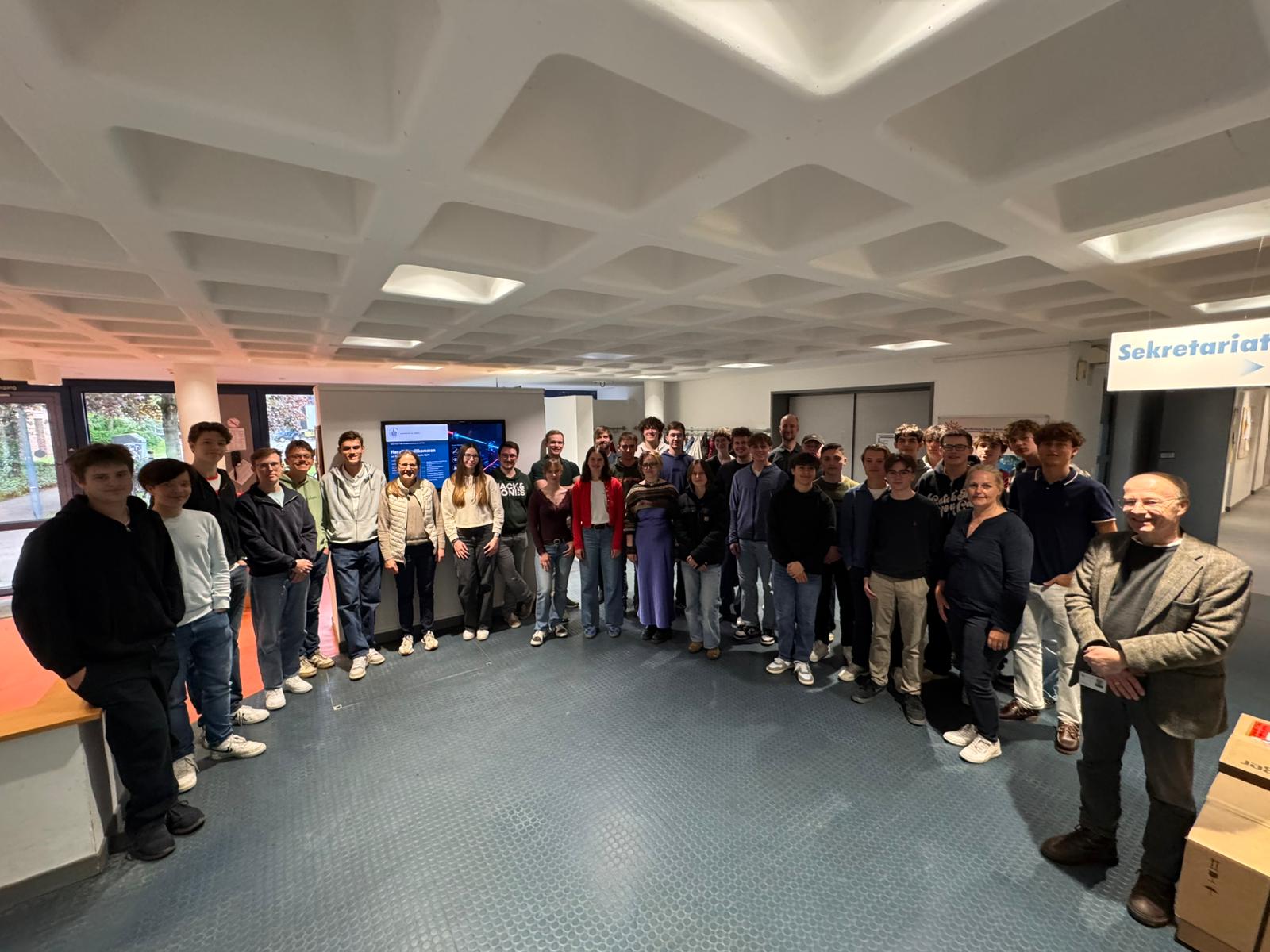
Twenty-seven high school students from Oberschule Zum Dom (physics track) visited our institute and had the opportunity to experience modern biomedical optics and laser technologies firsthand in our research laboratories. A big thank you to Sathurya Jagatheeswaran for organizing and accompanying the group!
After a brief introduction and welcome from our institute director, Prof. Dr. Robert Huber, the students gained fascinating insights into current research and innovative medical technology at four interactive stations:
Lasers in Surgery
Here, they learned how lasers are used in medicine today—precisely, gently, and with state-of-the-art technology (Kimberley Lühring, Dr. Birgit Lange). The students were able to experience how light is used in surgery and why optical technologies have become indispensable in modern operating rooms.
Slit-lamp OCT
This station focused on high-resolution imaging of the eye (Prof. Dr. Gereon Hüttmann). Using Optical Coherence Tomography (OCT), it was demonstrated how the finest structures can be made visible—a technology that is now indispensable in ophthalmology.
SLIDE - Ultrafast Microscopy
Here, visitors gained fascinating insights into modern laser microscopy and ultrafast imaging (Christian Stock, Stefan Reinhards). It was particularly impressive to see how today’s research can visualize microscopic processes at tremendous speeds.
4D Robotic OCT
A real highlight was the combination of robotics and optical imaging (Tjalfe Laedtke). The students were able to experience how intelligent robotic systems work together with OCT technology, opening up new possibilities for medical diagnostics and research.
Events like these consistently demonstrate how important it is to give young people early insights into science and research. It was particularly wonderful to see the students’ keen interest, their many questions, and their enthusiasm for our topics.
A heartfelt thank you goes to all the colleagues who prepared and presented the stations, thereby providing an exciting glimpse behind the scenes of modern research
Translated with DeepL.com (free version)